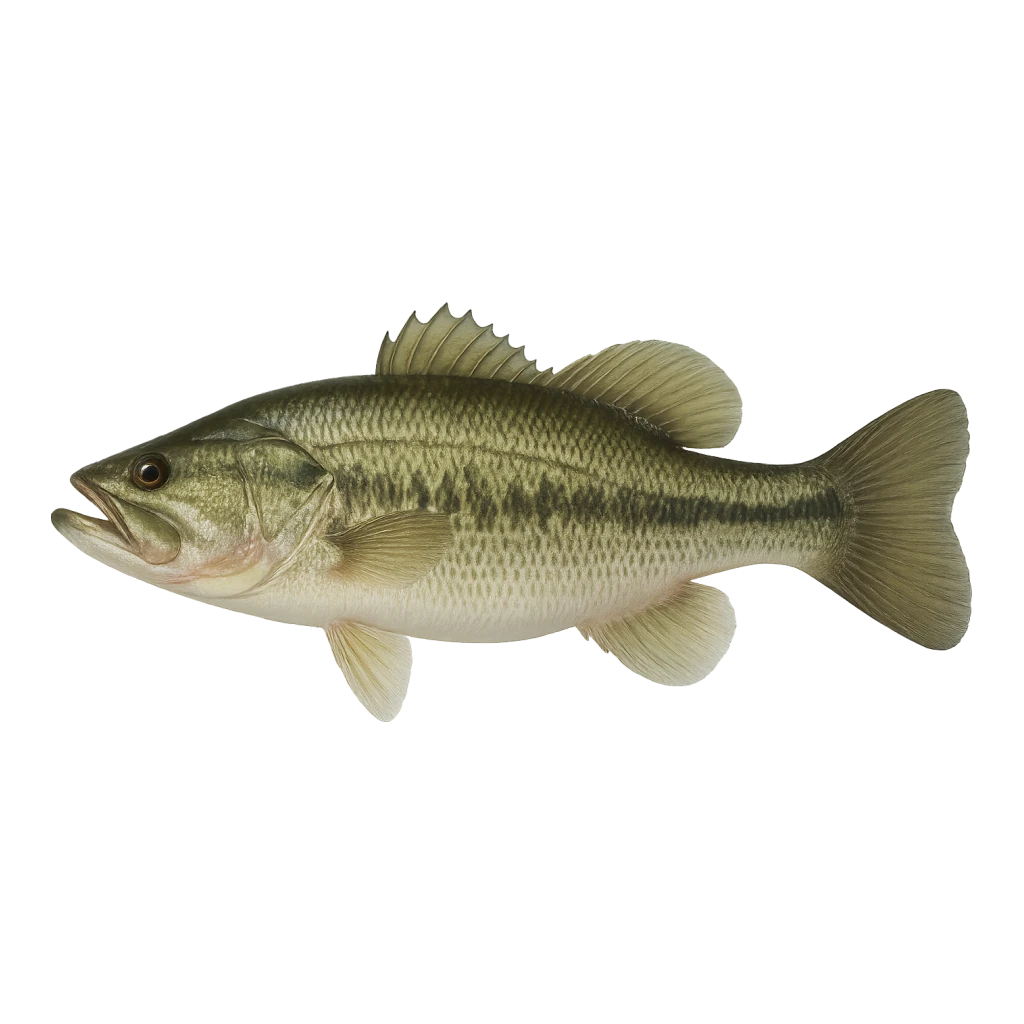
How to recognise it
The Largemouth Bass (Micropterus salmoides) is a robust freshwater fish. It has a broad, flattened head and a large mouth that extends past its eyes. The body is typically olive green to dark green with a lighter belly. A distinctive dark stripe runs along each side, from the snout to the base of the tail. The dorsal fin is divided into two parts, with the first part spiny and the second part soft. The Largemouth Bass is often confused with the Smallmouth Bass (Micropterus dolomieu). The key difference is that the Largemouth Bass has a larger mouth that extends beyond its eyes, while the Smallmouth Bass has a mouth that does not extend past its eyes.
Where it lives
Largemouth Bass are found throughout the United States, from the Northeast to the Southeast and into the Midwest. They prefer warm, freshwater habitats such as lakes, ponds, rivers, and reservoirs. They typically inhabit shallow waters, often in depths of 1 to 15 feet. Largemouth Bass are known to seek cover in structures like submerged logs, rocks, and aquatic vegetation. In spring and summer, they move closer to the shore for spawning and feeding. In fall and winter, they may retreat to deeper waters as temperatures drop.
When it bites
Largemouth Bass are most active from late spring to early fall. They bite best when water temperatures range from 65 to 85 degrees F. Early mornings and late afternoons are prime times for fishing. Weather changes, such as a passing front or increased wind, can trigger feeding activity. A full moon may also enhance their feeding behavior, making them more aggressive and active at night.
How to catch it
To catch Largemouth Bass, anglers often use a variety of rigs and lures. Popular rigs include Texas rigs and Carolina rigs. For baits, try plastic worms, jigs, or topwater lures. Sizes for plastic worms typically range from 4 to 10 inches, while jigs can be 1/4 to 1/2 ounce. Colors like green pumpkin, watermelon, and black/blue are effective. Use a monofilament or braided line in the 10 to 20-pound test range, with hooks sized from 2/0 to 5/0. Cast near cover and retrieve slowly, allowing the bait to mimic natural movement. Vary your retrieve speed to find what triggers a bite.
Size, age and the table
The typical size for a Largemouth Bass caught by anglers ranges from 1 to 5 pounds, with lengths between 12 and 20 inches. A trophy Largemouth Bass is generally considered to be over 8 pounds. Growth rates can vary based on habitat and food availability, but they can reach maturity in 2 to 4 years. Largemouth Bass can live up to 10 to 16 years in the wild. They are considered good eating, with firm, white flesh. When handling for release, wet your hands to avoid removing their protective slime layer and minimize stress by keeping them in the water as much as possible.