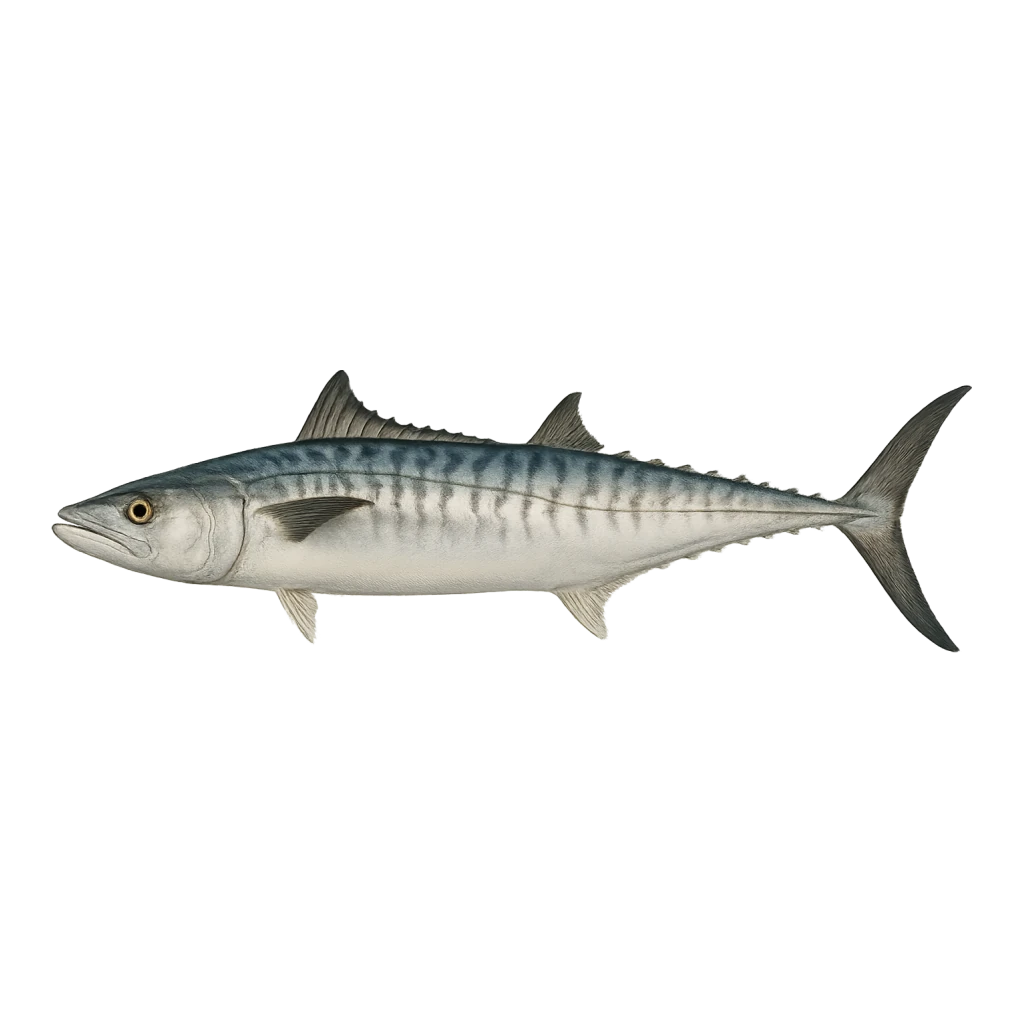
How to recognise it
The King Mackerel, or Scomberomorus cavalla, is a streamlined fish known for its speed and agility. It has a long, slender body with a pointed snout. The upper body is dark blue to greenish-blue, while the belly is silver. A distinctive feature is the series of vertical, yellowish stripes along its sides. The dorsal fin is long and has a sharp edge, while the mouth is large with sharp teeth. The species it is most often confused with is the Spanish Mackerel (Scomberomorus maculatus). The key detail that separates them is the absence of spots on the King Mackerel's body.
Where it lives
King Mackerel are found along the Atlantic coast of the United States, from Massachusetts to Florida, and in the Gulf of Mexico. They prefer warm, saltwater environments and are typically found in depths ranging from 30 to 100 feet. They often inhabit areas near reefs, wrecks, and other structures. In the summer, they move closer to shore, while in the winter, they migrate to deeper waters.
When it bites
King Mackerel are most active from April to October. They prefer water temperatures between 70°F and 85°F. Early morning and late afternoon are the best times to catch them. A passing front can trigger feeding activity, while strong winds may make them less active. A full moon can also enhance their feeding behavior, making them more likely to bite.
How to catch it
To catch King Mackerel, anglers often use trolling rigs with live bait such as menhaden or mullet. A common rig is a wire leader with a 4/0 to 6/0 hook. Lures like spoons or diving plugs in silver or blue colors are effective, typically ranging from 4 to 8 inches in length. Cast near structures or schools of baitfish and retrieve at a steady speed. Trolling at 5 to 7 knots can also be productive.
Size, age and the table
Anglers typically encounter King Mackerel ranging from 20 to 40 inches in length and weighing between 5 to 30 pounds. A trophy fish is often considered to be over 40 inches. They grow rapidly, reaching maturity in about 2 to 3 years and can live up to 10 years. King Mackerel are known for their excellent eating quality, with firm, flavorful flesh. When handling, it is important to use care to avoid injury from their sharp teeth. If releasing, do so quickly to minimize stress.