
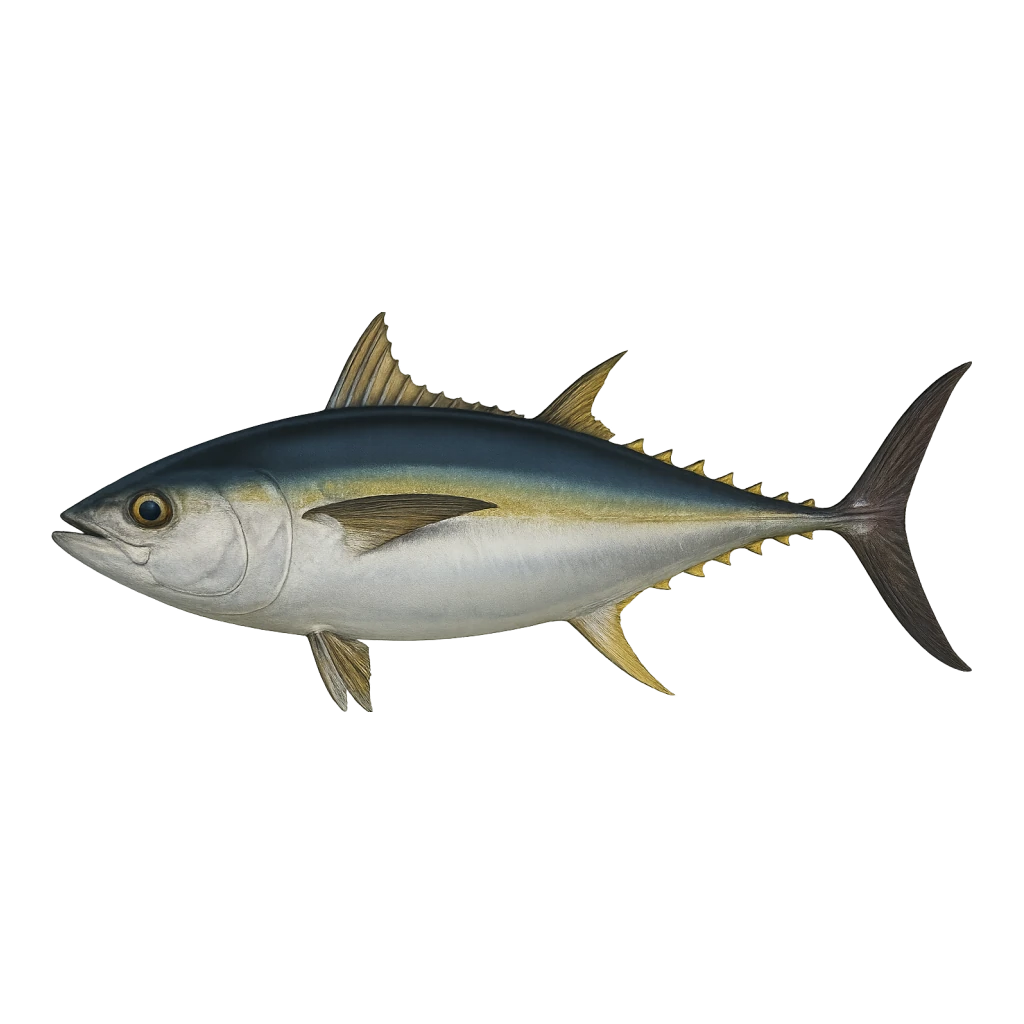
How to recognise it
The Bigeye Tuna (Thunnus obesus) is a robust fish with a streamlined body. It has a dark blue to blackish back, silver sides, and a pale belly. The most distinctive feature is its large, round eyes, which help it see in low-light conditions. The first dorsal fin is tall and pointed, while the second dorsal fin is smaller and located further back. The pectoral fins are long and can be folded back against the body. The Bigeye Tuna is often confused with the Yellowfin Tuna (Thunnus albacares). The key detail that separates them is the size of the eyes; Bigeye Tuna have significantly larger eyes compared to Yellowfin Tuna.
Where it lives
The Bigeye Tuna is found in tropical and subtropical waters. In the U.S., it ranges from the Atlantic coast of Florida to the Gulf of Mexico and along the Pacific coast, including Hawaii. This species prefers offshore waters, typically found at depths of 330 to 1,640 feet. They often inhabit areas with temperature ranges between 70 and 85 degrees F. During warmer months, they may move to shallower waters, while in cooler months, they tend to go deeper. They are often found near floating objects or in areas with high concentrations of baitfish.
When it bites
Bigeye Tuna are most active from May to October. They prefer water temperatures between 72 and 82 degrees F. The best times to fish for them are early morning and late afternoon. A passing cold front can trigger feeding activity, while a full moon may also enhance their bite. Windy conditions can scatter baitfish, making it harder to locate Bigeye Tuna, but they may still be caught if you find the right structure or current.
How to catch it
To catch Bigeye Tuna, use a variety of rigs such as trolling with lures or live bait. Recommended lures include cedar plugs, skirted trolling lures, and diving plugs in sizes ranging from 6 to 12 inches. Colors that work well are blue and silver, green, or pink. For live bait, consider using small tuna or mackerel. Use a strong line, typically 50 to 80-pound test, and a circle hook size 7/0 to 10/0. Cast near floating debris or current edges, and work the lure with a steady retrieve, allowing for occasional pauses to mimic injured prey.
Size, age and the table
Anglers typically encounter Bigeye Tuna ranging from 30 to 100 pounds. A trophy Bigeye Tuna is generally considered to be over 200 pounds. They grow rapidly, reaching sexual maturity at about 3 to 4 years of age. The lifespan of a Bigeye Tuna can exceed 10 years. The flesh is known for its quality, making it a popular choice for sushi and sashimi. When handling, use wet hands or gloves to avoid damaging the skin. For catch and release, minimize air exposure and handle the fish gently to ensure its survival.


