
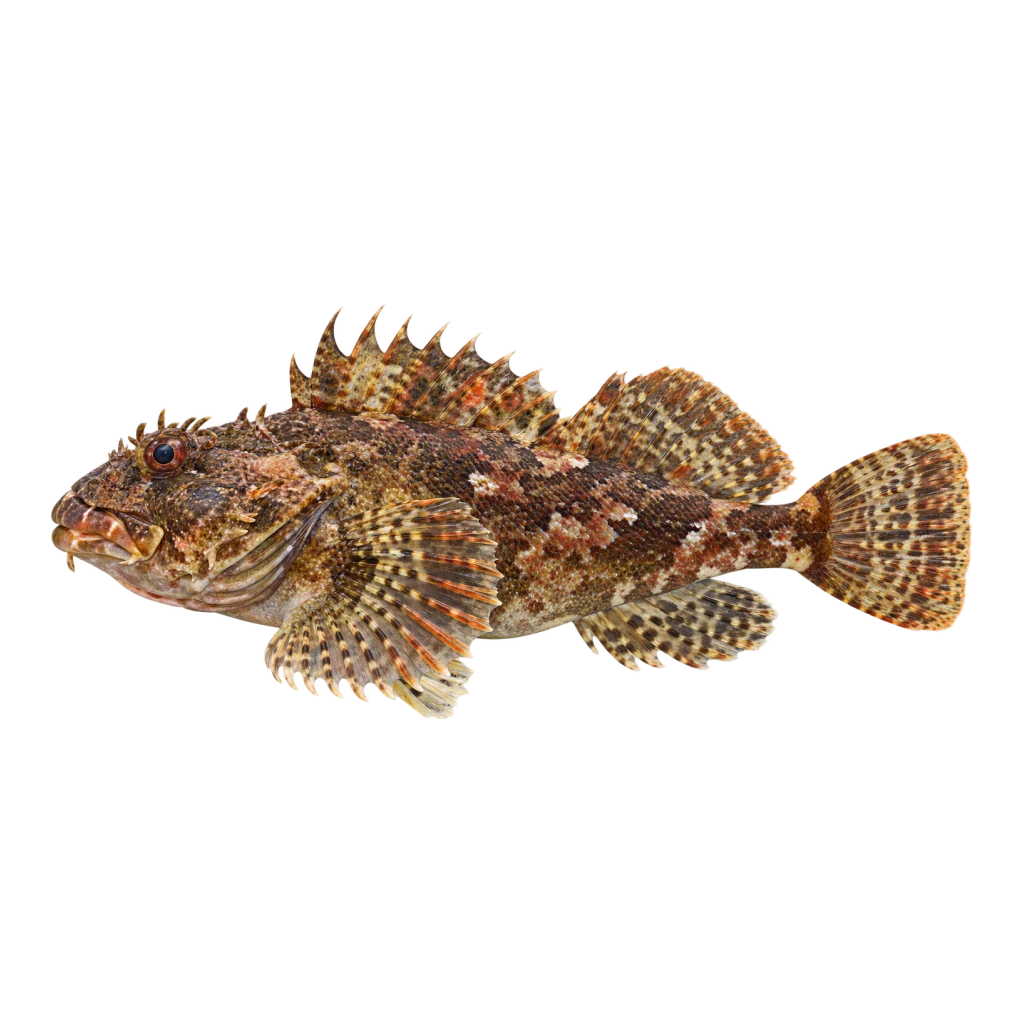
How to recognise it
The cabezon (Scorpaenichthys marmoratus) is a robust fish with a broad head and a large mouth. Its body is covered in a mottled pattern of green, brown, and gray, which helps it blend into rocky environments. The dorsal fin is long and continuous, extending from the head to the tail, while the pectoral fins are wide and rounded. Cabezon have a distinctive set of fleshy, tentacle-like structures above their eyes. They are often confused with the rockfish, but cabezon can be identified by their larger, more pronounced head and the lack of a prominent lateral line.
Where it lives
Cabezon are primarily found along the Pacific Coast of the United States, from Alaska down to Southern California. They inhabit rocky reefs, kelp forests, and sandy bottoms. Typically, they are found at depths ranging from 10 to 300 feet. In the warmer months, cabezon tend to move shallower, often seeking cover among rocks and kelp. During colder months, they may retreat to deeper waters, where they remain less active.
When it bites
Cabezon are most active from late spring through early fall, particularly from May to September. They prefer water temperatures between 55°F and 65°F. Early morning and late afternoon are prime times for fishing, as cabezon are more likely to feed during these hours. Weather changes, such as a passing front or increased wind, can trigger feeding activity. A full moon may also enhance their feeding behavior, making them more aggressive.
How to catch it
To catch cabezon, anglers often use bottom fishing rigs with a 1-3 ounce weight, depending on the depth. Effective baits include live or frozen shrimp, sand crabs, and small fish like herring. Lures such as jigs in bright colors (chartreuse or pink) can also be effective. Use a strong line, typically 20-30 lb test, and a sturdy hook size 2/0 to 4/0. Cast near rocky structures or kelp beds and work the bait or lure slowly along the bottom, allowing it to bounce off rocks to attract attention.
Size, age and the table
Anglers typically encounter cabezon ranging from 10 to 30 inches in length, with weights between 5 to 15 pounds. A trophy cabezon is generally considered to be over 30 inches. They grow relatively quickly, reaching sexual maturity around 3-5 years of age and can live up to 15 years. The flesh of cabezon is firm and white, making it a desirable catch for eating. When handling cabezon, use care to avoid injury from their spines. If releasing, do so gently to minimize stress and increase survival chances.


