
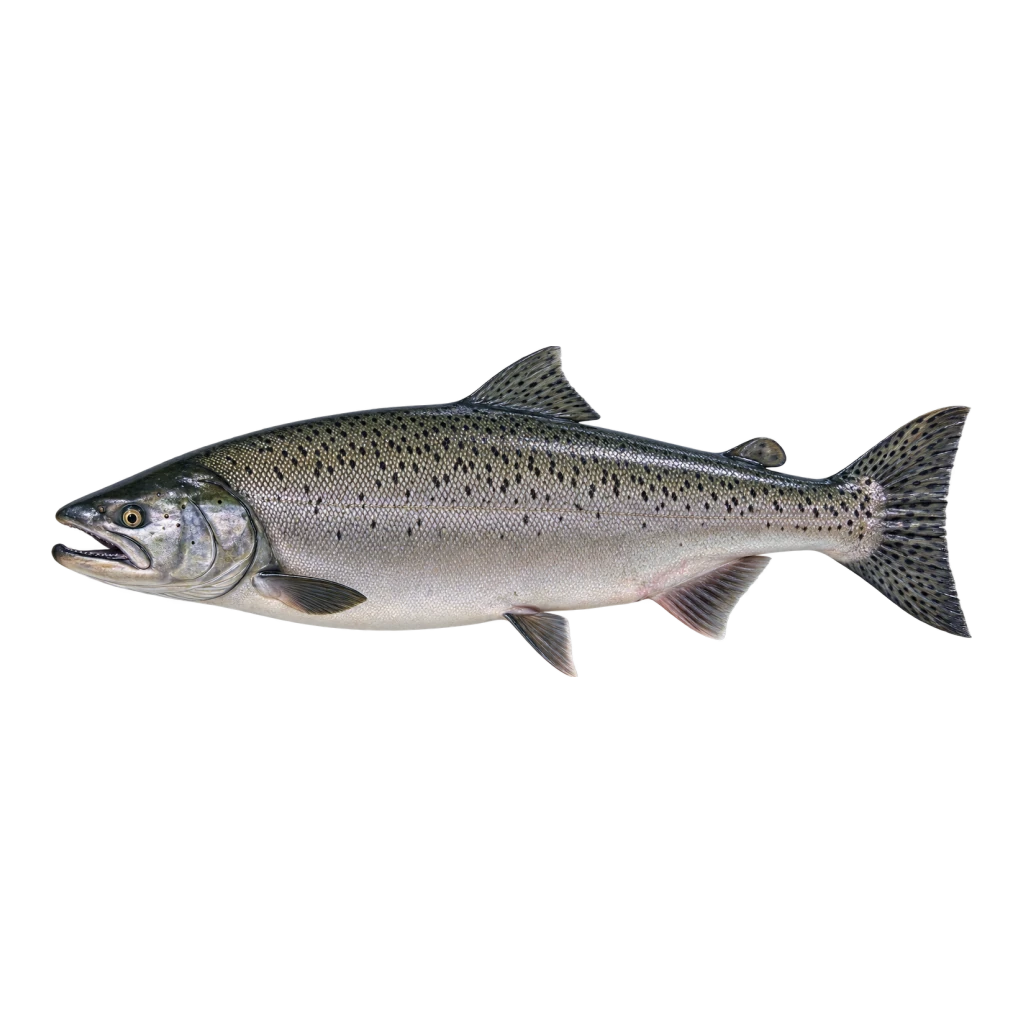
How to recognise it
The Chinook Salmon, or Oncorhynchus tshawytscha, is a large fish known for its streamlined body. It typically has a blue-green back, silvery sides, and a white belly. During spawning, its color changes to a dark red or maroon. The species has large, black spots on its back and upper lobe of the tail. The mouth is large with sharp teeth, and the gums are black. Chinook Salmon are often confused with Coho Salmon (Oncorhynchus kisutch). The key detail that separates them is the number of spots; Chinook have spots on both their back and tail, while Coho only have spots on their back.
Where it lives
Chinook Salmon are found along the Pacific Coast of North America. Their range extends from the Bering Sea in Alaska down to California. They inhabit both freshwater and saltwater environments. In freshwater, they prefer rivers and streams for spawning. In saltwater, they are commonly found in coastal waters and estuaries. Depths can vary from 20 to 300 feet, depending on the time of year and water temperature. In summer, they tend to move deeper to find cooler waters, while in winter, they may be found closer to the surface.
When it bites
Chinook Salmon are most active from late spring through early fall. They prefer water temperatures between 50 and 65 degrees F. Early morning and late evening are the best times to fish for them. A passing front can trigger feeding activity, while strong winds may scatter them. A full moon can also enhance their feeding behavior, making them more likely to bite.
How to catch it
To catch Chinook Salmon, use downriggers with a variety of rigs. Popular setups include flasher and hoochie combinations or spoons. Sizes for spoons typically range from 3 to 5 inches, with colors like silver, blue, and green being effective. Bait options include herring, anchovies, or salmon eggs. Use a line strength of 20 to 30 pounds and a hook size of 2/0 to 5/0. Cast near river mouths, estuaries, or in deeper waters during their migration. Work the lures with a slow, steady retrieve to mimic injured prey.
Size, age and the table
Chinook Salmon typically range from 20 to 40 inches in length and weigh between 10 to 50 pounds. A trophy Chinook is often considered to be over 30 pounds. They grow quickly, reaching maturity in 3 to 5 years, and can live up to 7 years or more. The flesh is known for its rich flavor and high oil content, making it a sought-after catch. Handle them carefully to avoid injury, and use proper techniques for release to ensure their survival after catch.


