
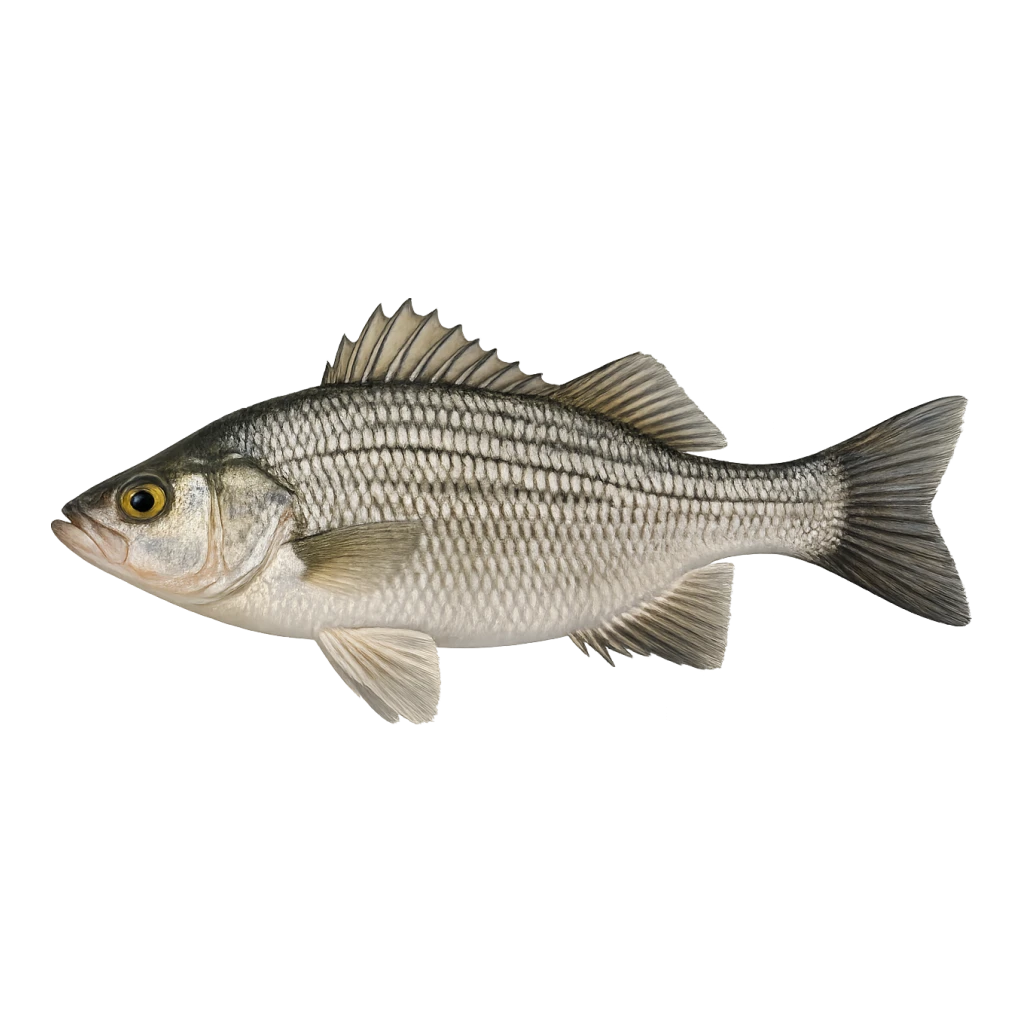
How to recognise it
The White Perch (Morone americana) is a slender fish with a streamlined body. It has a silver-white coloration with a slightly darker back. The sides are marked with several horizontal black stripes. The dorsal fin is long and continuous, with the first part spiny and the second part soft. The mouth is medium-sized, with a slightly protruding lower jaw. White Perch is often confused with the Striped Bass. The key detail that separates them is the absence of a pronounced lateral line on the White Perch.
Where it lives
White Perch are found along the Atlantic Coast of the United States, from Maine to South Carolina. They inhabit brackish waters, including estuaries, bays, and rivers. They prefer depths of 3 to 30 feet. In spring and summer, they move into shallower waters to spawn. During fall and winter, they may migrate to deeper areas. They often seek cover around structures like submerged rocks, vegetation, and piers.
When it bites
White Perch are most active from April to October. They prefer water temperatures between 60°F and 75°F. Early morning and late evening are the best times to catch them. A passing cold front can trigger feeding, while strong winds may make them less active. A full moon can also enhance their feeding behavior, making them more likely to bite during the night.
How to catch it
Effective rigs for catching White Perch include the drop shot rig and the jigging rig. Use small jigs ranging from 1/16 to 1/8 ounce in colors like white, chartreuse, and pink. Live baits such as minnows and worms are also effective. Use a 6 to 10-pound test line with size 6 to 10 hooks. Cast near structures and work the bait slowly, allowing it to bounce along the bottom. Vertical jigging can be effective in deeper waters.
Size, age and the table
Anglers typically encounter White Perch ranging from 8 to 12 inches. A trophy White Perch is considered to be over 14 inches. They grow quickly, reaching maturity in about 2 to 3 years. The lifespan of a White Perch can be up to 10 years. They are known for their good eating quality, with a mild flavor and firm texture. Handle them carefully to ensure a successful release if not keeping for consumption.


