
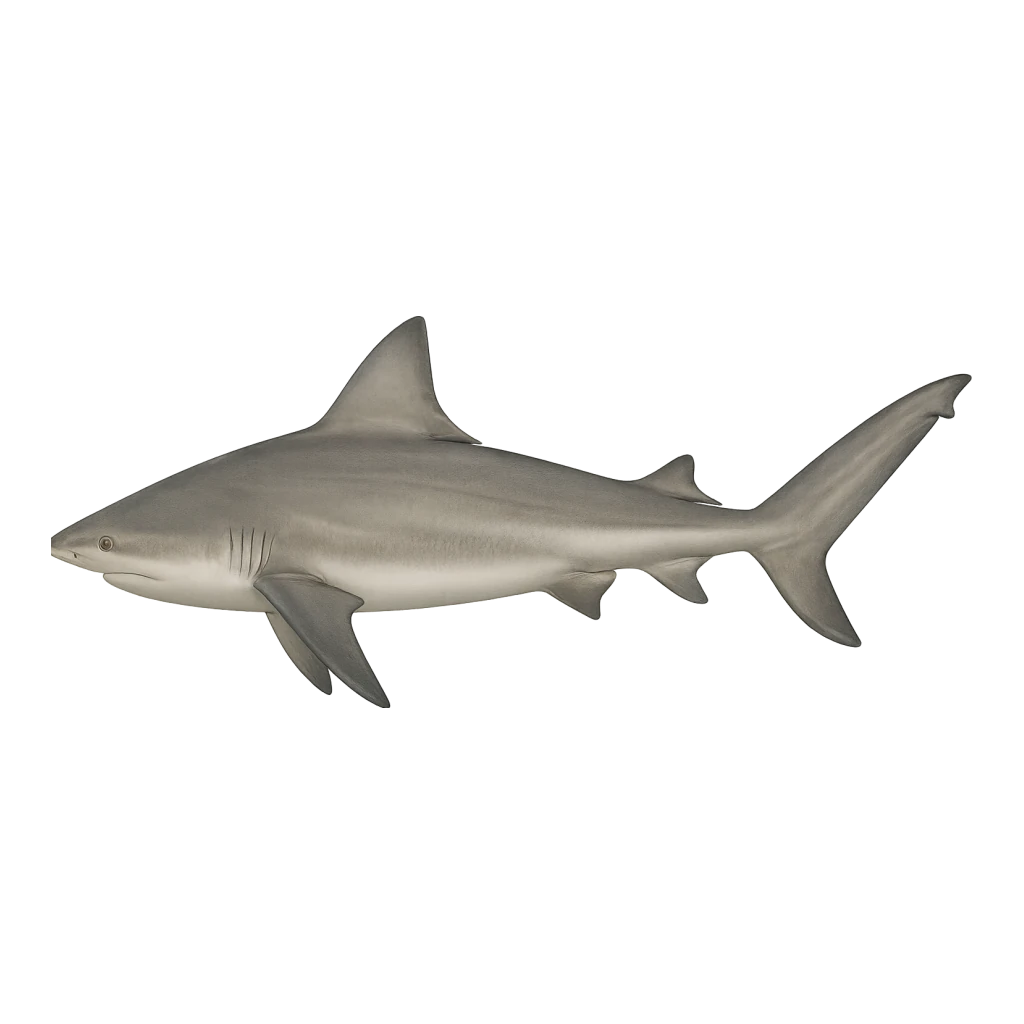
How to recognise it
The Bull Shark (Carcharhinus leucas) is a robust species known for its distinctive features. It has a broad, flat snout and a large mouth filled with sharp, serrated teeth. The coloration is typically gray on the top and white on the underside, providing camouflage in the water. The dorsal fin is tall and triangular, while the pectoral fins are wide and slightly curved.
This species is often confused with the Tiger Shark (Galeocerdo cuvier). The key detail that separates them is the Bull Shark's more rounded snout compared to the Tiger Shark's elongated, pointed snout.
Where it lives
Bull Sharks are found in various regions across the United States. They inhabit coastal waters from Florida to Texas along the Gulf of Mexico, and up the Atlantic coast to New Jersey. They are known to thrive in brackish waters, often found in estuaries, rivers, and lagoons.
In terms of depth, Bull Sharks typically range from shallow waters of 3 to 30 feet but can be found at depths of up to 100 feet. They prefer areas with structure, such as submerged rocks, mangroves, and piers. Seasonal changes can affect their location; during warmer months, they may venture further upstream into freshwater systems, while in colder months, they tend to stay in deeper, more stable environments.
When it bites
Bull Sharks are most active from late spring through early fall, particularly from May to October. They prefer water temperatures between 70°F and 85°F. The best times to fish for them are early morning and late afternoon, coinciding with their feeding patterns.
Environmental factors can influence their behavior. A passing front may trigger increased activity, while strong winds can make them less aggressive. Full moons can enhance feeding opportunities, as the increased light allows them to hunt more effectively at night.
How to catch it
To target Bull Sharks, use heavy tackle. Recommended rigs include a wire leader to prevent bite-offs, with a minimum line strength of 50-80 pounds. Circle hooks in sizes 6/0 to 10/0 are effective for hooking them securely.
For bait, consider using chunks of mullet, bonito, or stingray, cut into pieces about 6-8 inches long. Live bait such as small fish can also be effective. When using lures, opt for large, heavy jigs or swimbaits in bright colors like chartreuse or orange, which can attract their attention.
Cast near structures like piers, jetties, or river mouths, and allow the bait to settle on the bottom. Retrieve slowly, with occasional pauses to mimic injured prey. Be prepared for a strong fight when hooked.
Size, age and the table
Anglers typically encounter Bull Sharks ranging from 5 to 8 feet in length, with weights between 150 to 300 pounds. A trophy Bull Shark is generally considered to be over 8 feet long.
Growth rates vary, but Bull Sharks can reach maturity at around 4 to 6 years of age. They have a lifespan of approximately 12 to 16 years in the wild. While their meat is edible, it is often considered to have a strong flavor and may contain high levels of mercury, so consumption should be approached with caution.
When handling Bull Sharks, use care due to their powerful jaws and sharp teeth. If releasing, do so quickly to minimize stress and increase survival chances.


