
How to recognise it
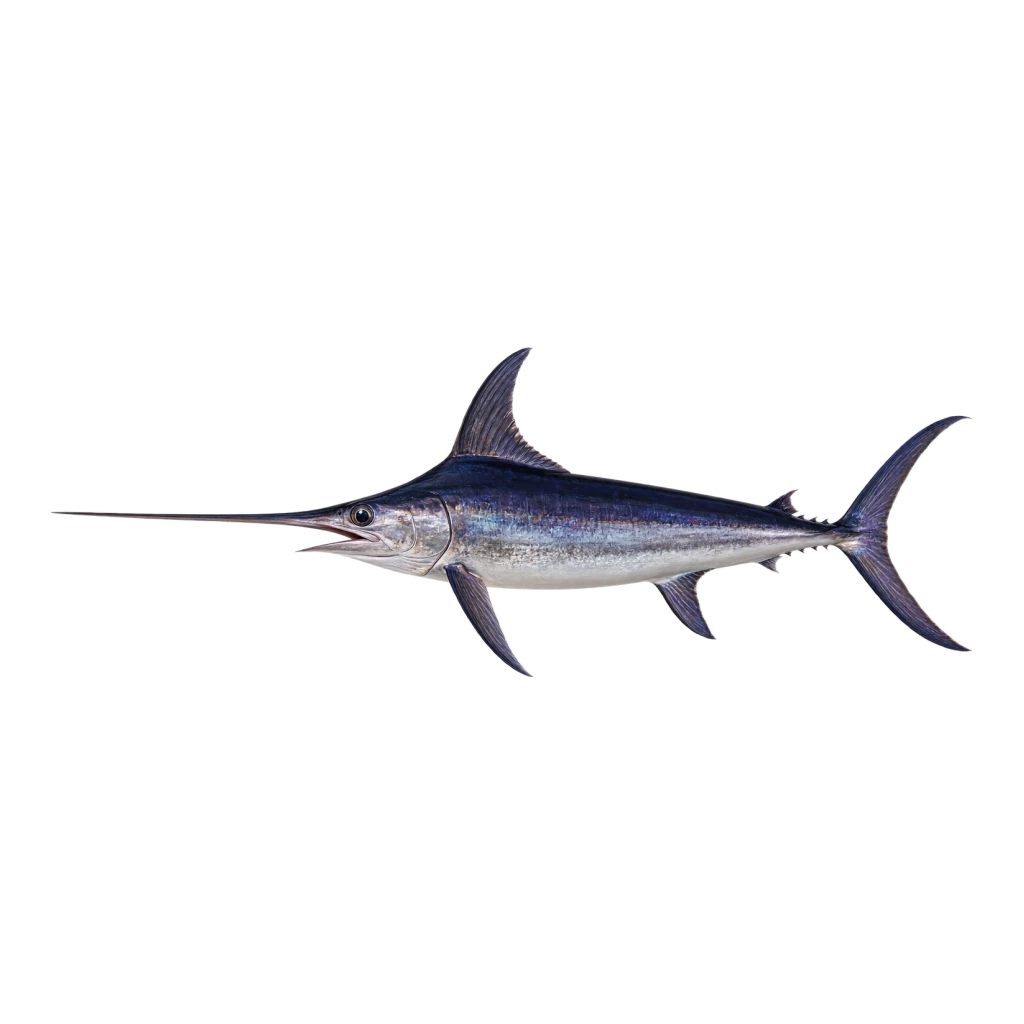
The Swordfish (Xiphias gladius) is a large, powerful fish known for its elongated, flat bill. It has a streamlined body that can reach lengths of up to 12 feet and weights exceeding 1,000 pounds. The coloration is typically dark blue to gray on the top, fading to a lighter, silvery hue on the sides and belly. The dorsal fin is tall and triangular, while the anal fin is long and pointed. The Swordfish's most distinctive feature is its bill, which is long and sword-like, used for slashing at prey.
This species is often confused with the Marlin, particularly the Blue Marlin. The key detail that separates them is the shape of the bill; the Swordfish has a flat, sword-like bill, while the Marlin has a more rounded, pointed bill.
Where it lives
The Swordfish is found in the Atlantic, Pacific, and Indian Oceans. In the United States, it ranges from the Gulf of Mexico to the northeastern coast, including areas like Florida, the Carolinas, and New England. Swordfish prefer warm waters, typically inhabiting the open ocean rather than coastal areas. They are commonly found at depths ranging from 200 to 1,200 feet, often near the surface at night.
Seasonally, Swordfish migrate to warmer waters during the winter months and return to cooler areas in the summer. They are known to follow prey, which influences their location throughout the year.
When it bites
Swordfish are most active from late spring to early fall, particularly from May to September. They prefer water temperatures between 70°F and 85°F. The best times to fish for Swordfish are during the early morning and late evening hours, as they tend to feed more actively at these times.
Weather conditions can impact their feeding behavior. A passing front can trigger increased activity, while strong winds may make fishing more challenging. A full moon can enhance their feeding patterns, making them more likely to bite.
How to catch it
To catch Swordfish, anglers often use a variety of rigs, including the circle hook rig and the kite fishing rig. Recommended baits include large live baits such as mackerel or squid, as well as dead baits like bonito. Lures in bright colors, such as pink, blue, or chartreuse, can also be effective.
Use heavy tackle with a line strength of at least 80 to 200-pound test. Hooks should be sized between 8/0 and 12/0, depending on the bait used. When fishing, target areas where currents converge or near underwater structures. Work the bait by allowing it to drift naturally or by using a slow trolling method.
Size, age and the table
Anglers typically encounter Swordfish ranging from 100 to 300 pounds, with trophies often exceeding 400 pounds. Swordfish can grow rapidly, reaching maturity at around 4 to 5 years of age, and can live up to 9 years or more.
In terms of eating quality, Swordfish is highly regarded for its firm, meaty texture and rich flavor. Proper handling is crucial to maintain quality; keep the fish cool and avoid prolonged exposure to sunlight. When releasing, minimize handling and return the fish to the water as quickly as possible to ensure its survival.


