
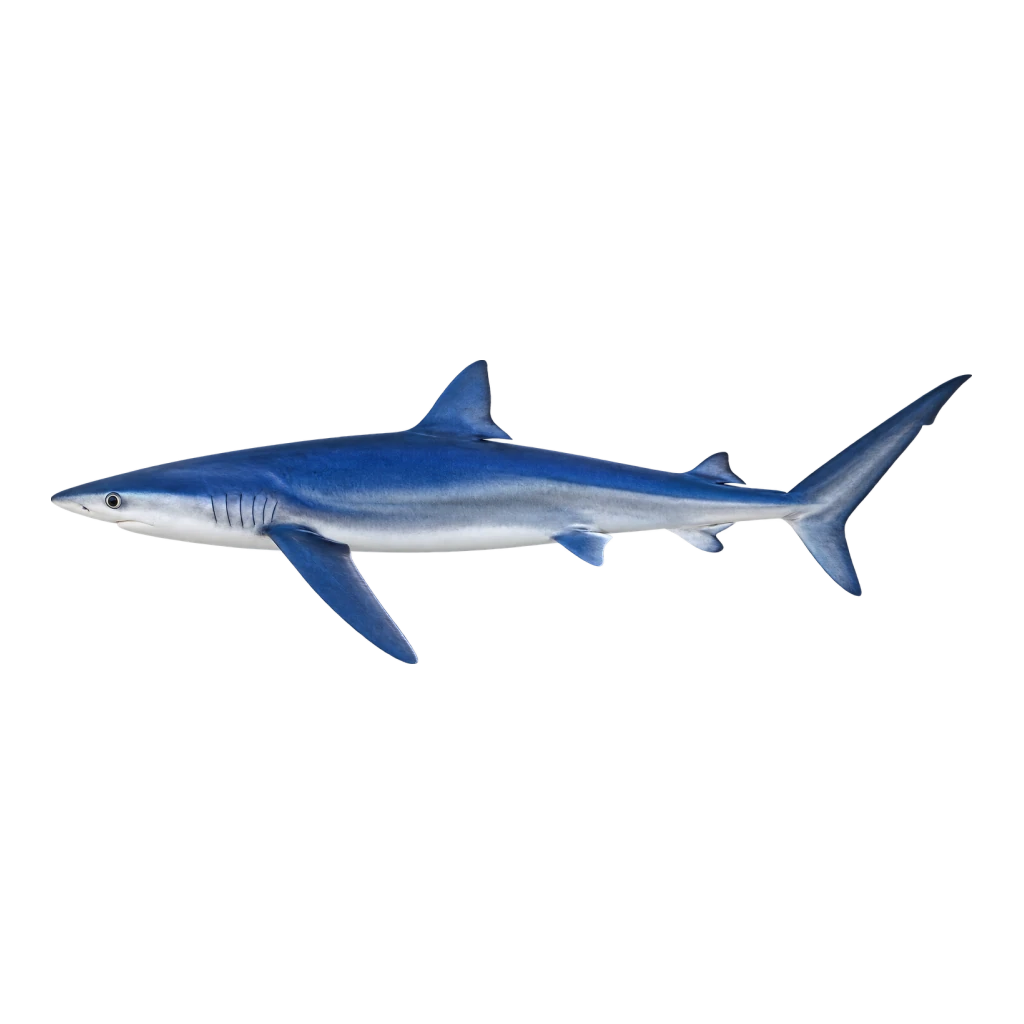
How to recognise it
The Blue Shark (Prionace glauca) is a streamlined, slender shark known for its striking coloration. It has a long, pointed snout and large, triangular pectoral fins. The upper body is a vibrant blue, while the underside is white, providing effective camouflage in the water. The mouth is long and filled with sharp teeth. This species is often confused with the Mako Shark. The key detail that separates them is the Blue Shark's longer, more slender body compared to the Mako's stockier build.
Where it lives
The Blue Shark is found along the Atlantic and Pacific coasts of the United States. In the Atlantic, it ranges from Maine to Florida, while in the Pacific, it can be found from Alaska to California. This species prefers offshore waters but can also be found near the coast. They inhabit depths of 100 to 1,000 feet, often near the surface. In warmer months, they move closer to shore, while in colder months, they tend to migrate to deeper waters.
When it bites
Blue Sharks are most active from late spring through early fall, particularly from May to October. They prefer water temperatures between 60°F and 75°F. The best time to catch them is during the early morning and late afternoon. A passing front can increase their feeding activity, while strong winds or a full moon may make them less active.
How to catch it
To catch Blue Sharks, use a variety of rigs such as the wire leader rig or the balloon rig. Common baits include mackerel, squid, and bonito, typically in sizes ranging from 6 to 12 inches. Lures can also be effective, with colors like blue, silver, and chartreuse being popular. Use a strong line, typically 50 to 80-pound test, and hooks sized 6/0 to 9/0. Cast your bait or lure near schools of baitfish or in areas where you see surface activity. Retrieve slowly to mimic the movement of injured prey.
Size, age and the table
Anglers typically encounter Blue Sharks ranging from 5 to 8 feet in length, with weights between 100 and 300 pounds. A trophy Blue Shark is generally considered to be over 10 feet long. They grow rapidly, reaching maturity at around 4 to 5 years of age, and can live up to 20 years. While the meat is edible, it is often considered of lower quality compared to other shark species. Proper handling is essential to ensure a safe release, as they are known for their strong fight and agility.


