
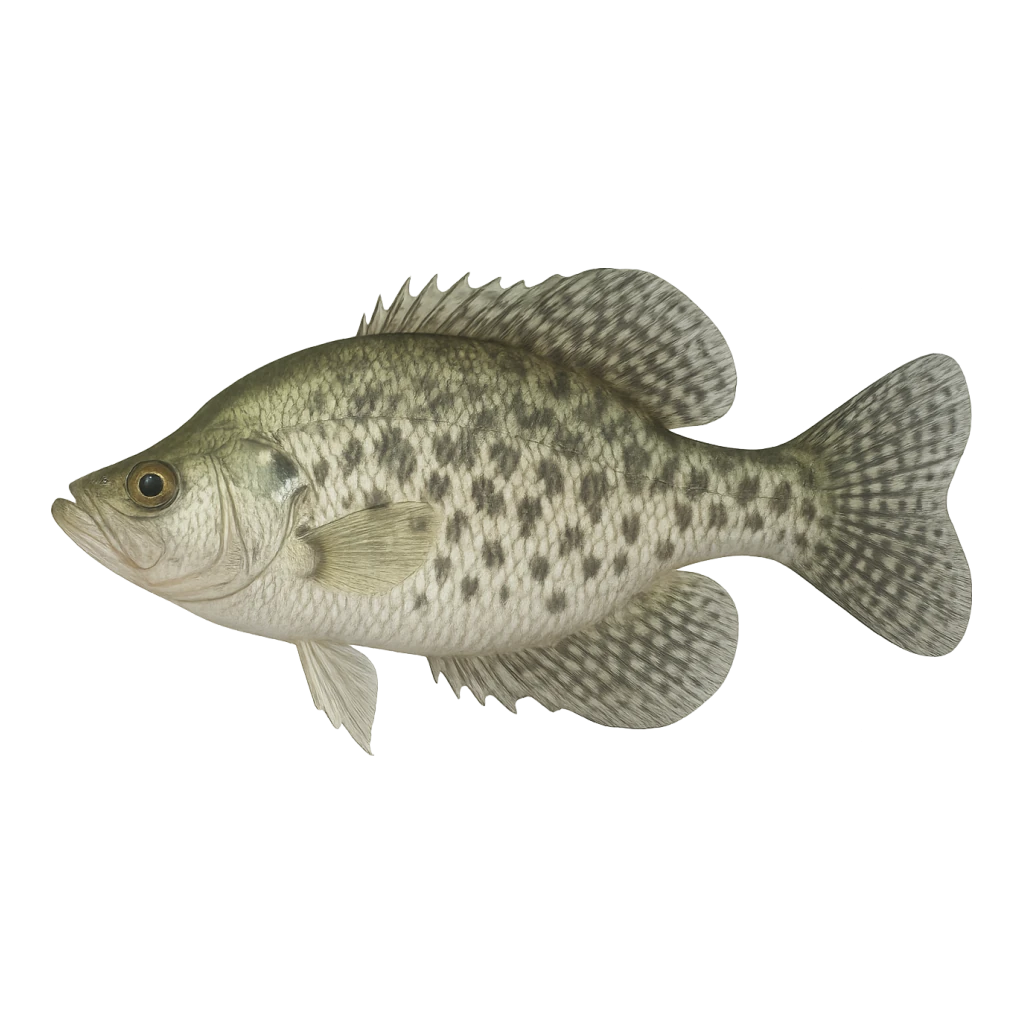
How to recognise it
The White Crappie (Pomoxis annularis) is a freshwater fish known for its distinctive features. It has a deep, laterally compressed body that can reach up to 19 inches in length. The coloration is typically silver to white with a pattern of dark spots. The dorsal fin is long and spiny, while the anal fin is shorter and rounded. The mouth is large, allowing it to consume a variety of prey.
This species is often confused with the Black Crappie (Pomoxis nigromaculatus). The key detail that separates them is the pattern of spots; White Crappies have vertical bars or stripes, while Black Crappies have scattered black spots.
Where it lives
White Crappies are found throughout the United States, primarily in the Midwest and Southern regions. They inhabit a variety of water types, including lakes, ponds, and rivers. They prefer warm, shallow waters with plenty of cover such as submerged trees, brush piles, and vegetation.
During the spring, they can be found in shallower waters, often in depths of 2 to 10 feet. In summer, they may move to deeper areas, around 10 to 20 feet, seeking cooler temperatures. In fall, they return to shallower waters as temperatures drop, while in winter, they can be found in deeper, more stable areas.
When it bites
White Crappies are most active from late spring through early fall. They typically bite best when water temperatures range from 65 to 75 degrees F. Early morning and late afternoon are prime times for fishing, as they tend to be more active during these hours.
Weather conditions can affect their feeding behavior. A passing cold front may slow their activity, while a warm front can trigger feeding. Wind can help by stirring up the water, making them more likely to bite. A full moon can also enhance their feeding activity, especially at night.
How to catch it
To catch White Crappies, anglers often use light tackle. Popular rigs include slip bobbers and jigs. A 1/16 to 1/8 ounce jig head paired with a soft plastic or live bait is effective. Colors like chartreuse, white, and pink are particularly successful.
Use a 4 to 6-pound test line and size 6 to 8 hooks. Cast near cover, such as submerged trees or brush piles, and retrieve slowly. A slow, steady retrieve or a gentle jigging motion can entice bites. Pay attention to the depth; adjust your bobber or jig to find where the fish are holding.
Size, age and the table
Anglers typically encounter White Crappies that are 8 to 12 inches long. A trophy-sized fish is usually considered to be over 15 inches. Growth rates can vary, but they generally reach 10 inches in about 2 to 3 years. The lifespan of a White Crappie can be up to 8 years.
White Crappies are known for their excellent eating quality. They have a mild flavor and flaky texture, making them a popular choice for cooking. When handling, use wet hands to avoid damaging their slime coat, and release them gently to ensure their survival.


