
How to recognise it
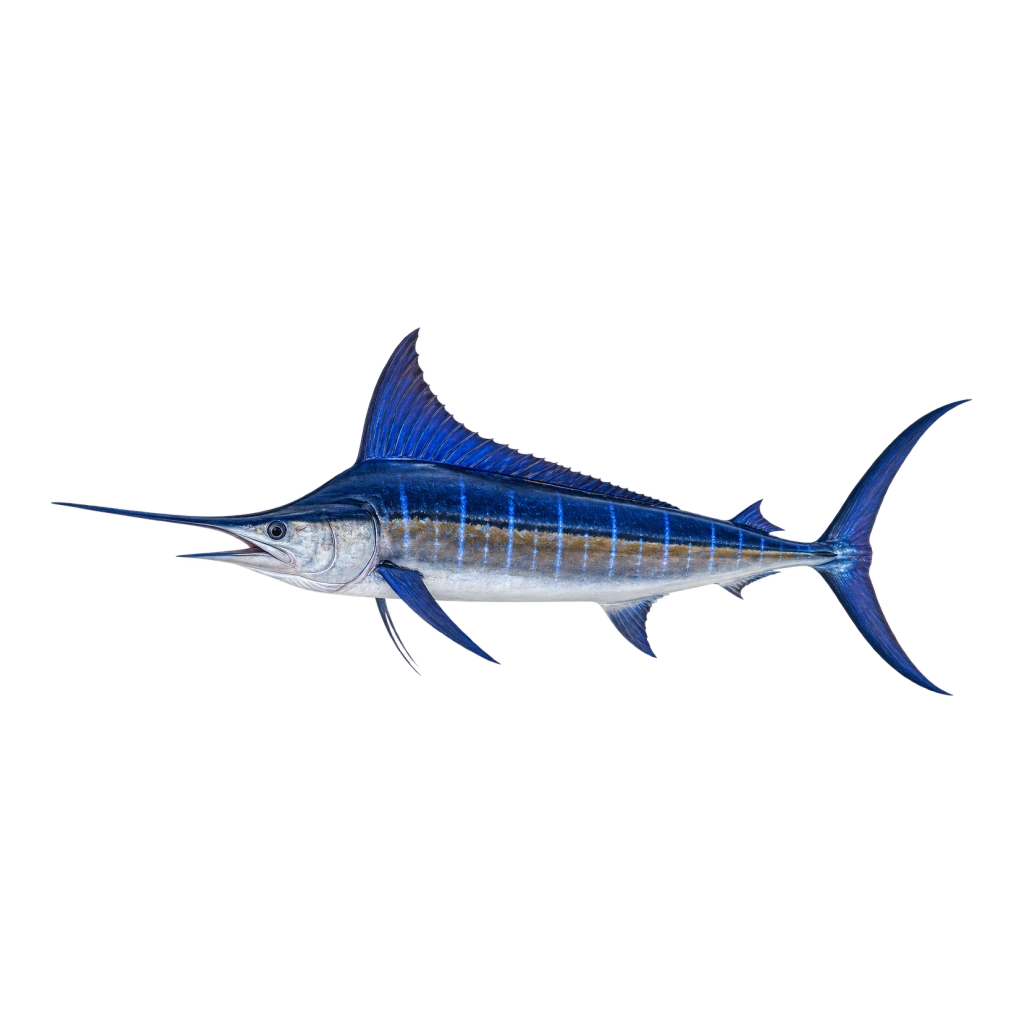
The Blue Marlin (Makaira nigricans) is a large, powerful fish known for its elongated body and distinctive features. It has a long, pointed bill and a dorsal fin that can be quite tall. The coloration is striking, with a deep blue upper body that fades to a silvery-white belly. The sides are often marked with vertical stripes that can be more pronounced in younger fish.
One species it is often confused with is the Black Marlin (Istiompax indica). The key detail that separates them is the shape of the dorsal fin; the Blue Marlin's dorsal fin is taller and more triangular compared to the more rounded fin of the Black Marlin.
Where it lives
The Blue Marlin is primarily found in the warm waters of the Atlantic Ocean. In the United States, its range extends from the Florida Keys to the Gulf of Mexico and along the eastern seaboard to the Carolinas. They prefer offshore waters, typically found in depths ranging from 100 to 1,000 feet.
During the summer months, Blue Marlin tend to move closer to shore, while in winter, they often migrate to deeper waters. They are usually found near structures such as underwater canyons, drop-offs, and floating debris, which provide cover and attract prey.
When it bites
Blue Marlin are most active from late spring through early fall, with peak months being June to September. They prefer water temperatures between 75 and 85 degrees F. The best time of day to target them is early morning or late afternoon.
Weather changes can influence their feeding behavior. A passing front may trigger increased activity, while strong winds can make them less likely to bite. A full moon can also enhance their feeding, as it provides more light for hunting.
How to catch it
To catch Blue Marlin, anglers often use trolling rigs with large baits or lures. Recommended baits include whole mackerel or tuna, typically in the 5 to 10-pound range. Lures should be bright and colorful, such as blue and white or green and yellow, and range from 10 to 12 inches in length.
Use a heavy-duty line, typically 80 to 130-pound test, with a strong hook size ranging from 8/0 to 12/0. When trolling, maintain a speed of 6 to 10 knots. Cast near underwater structures or current lines, and work the lures with a steady retrieve to mimic the movement of prey.
Size, age and the table
Anglers typically encounter Blue Marlin ranging from 100 to 300 pounds, with larger specimens sometimes exceeding 1,000 pounds. A trophy Blue Marlin is generally considered to be over 500 pounds.
The growth rate is relatively fast, with young fish reaching maturity at around 4 to 5 years of age. They can live up to 10 to 15 years in the wild. While Blue Marlin are not commonly eaten, they are known for their firm, white flesh. Proper handling is crucial to ensure a successful release, as they can be sensitive to stress and temperature changes.


