
How to recognise it
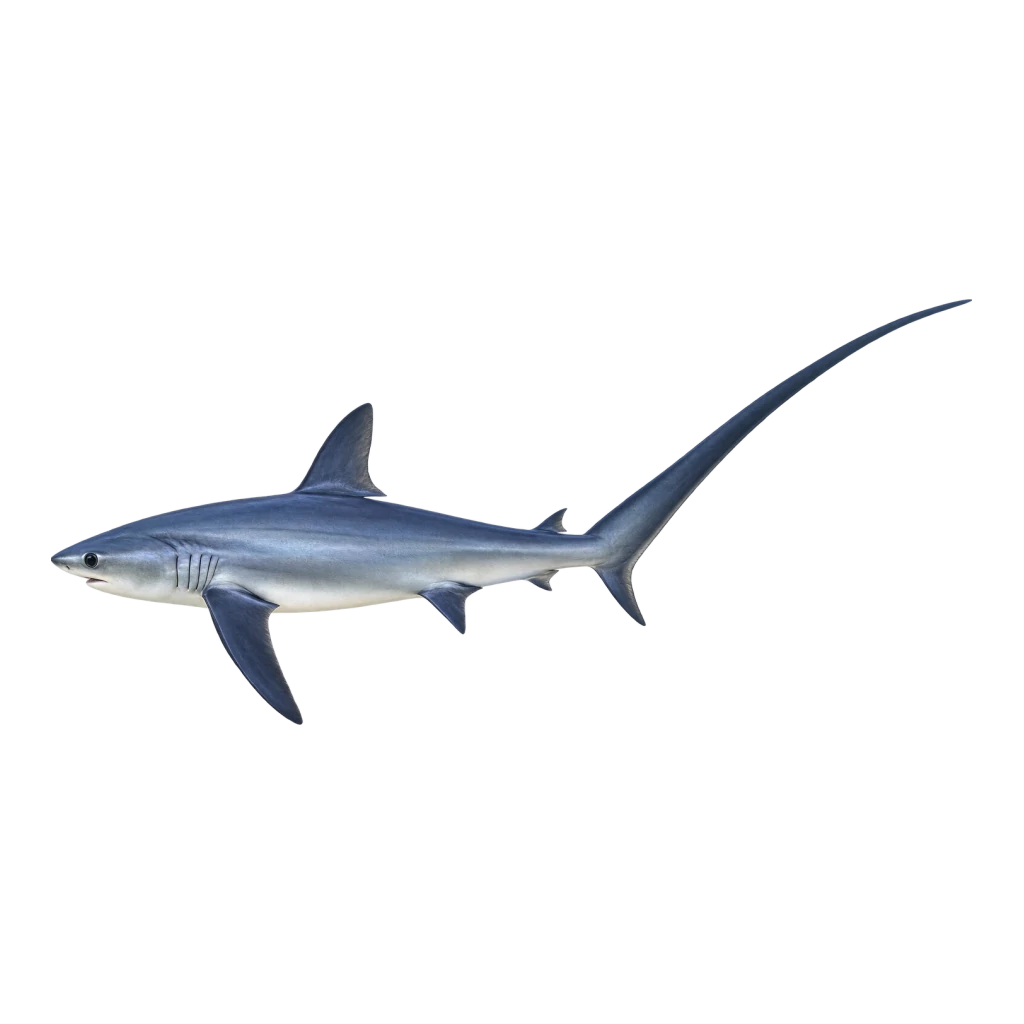
The Common Thresher Shark (Alopias vulpinus) is easily identifiable by its long, slender body and distinctive tail. It can reach lengths of up to 20 feet, but most caught by anglers are between 8 to 12 feet. The coloration is typically a bluish-gray on the top and white on the underside. Its dorsal fin is tall and triangular, while the pectoral fins are long and narrow.
One of the key features is its elongated upper lobe of the tail, which can be nearly as long as the body itself. This shark has a pointed snout and small, sharp teeth. It is often confused with the Longfin Mako Shark (Isurus paucus). The primary detail that separates them is the Thresher's long tail, which is much more pronounced than that of the Mako.
Where it lives
The Common Thresher Shark is found along the Atlantic and Pacific coasts of the United States. In the Atlantic, it ranges from Maine to Florida. In the Pacific, it can be found from Alaska down to California. This species prefers offshore waters, typically inhabiting depths of 100 to 1,000 feet.
During warmer months, they may move closer to shore, while in colder months, they tend to migrate to deeper waters. They often hold near underwater structures, such as canyons and ledges, where prey is abundant.
When it bites
The best months for targeting Common Thresher Sharks are from May to October. They are most active when water temperatures range from 60 to 75 degrees F. Early morning and late afternoon are prime times for bites.
Weather conditions can influence their feeding behavior. A passing front may trigger increased activity, while strong winds can make them less likely to bite. A full moon can also enhance their feeding, as it increases the visibility for hunting.
How to catch it
To catch a Common Thresher Shark, anglers often use a variety of rigs. A common choice is a wire leader rig with a circle hook, typically sized 8/0 to 10/0. Live bait such as mackerel or squid works well, as do large lures in bright colors like blue or chartreuse.
When fishing, cast your bait or lure near underwater structures or along the edges of currents. Trolling at speeds of 4 to 6 knots can be effective. Work the lure with a steady retrieve, allowing it to mimic the movement of prey.
Size, age and the table
Anglers typically encounter Common Thresher Sharks ranging from 8 to 12 feet in length. A trophy fish is generally considered to be over 12 feet. They grow quickly, reaching sexual maturity around 5 to 6 years of age, and can live up to 20 years.
While the meat is edible and considered good quality, it is often tough and best prepared in dishes that require marinating or slow cooking. Proper handling is essential to ensure a successful release. Use a dehooking device and minimize the time the shark is out of water to increase its chances of survival.


